Familiengeschichte Daßler / Dassler Family History
Sprecher: Christian Hoyer, Quelle: Stadtmuseum Herzogenaurach
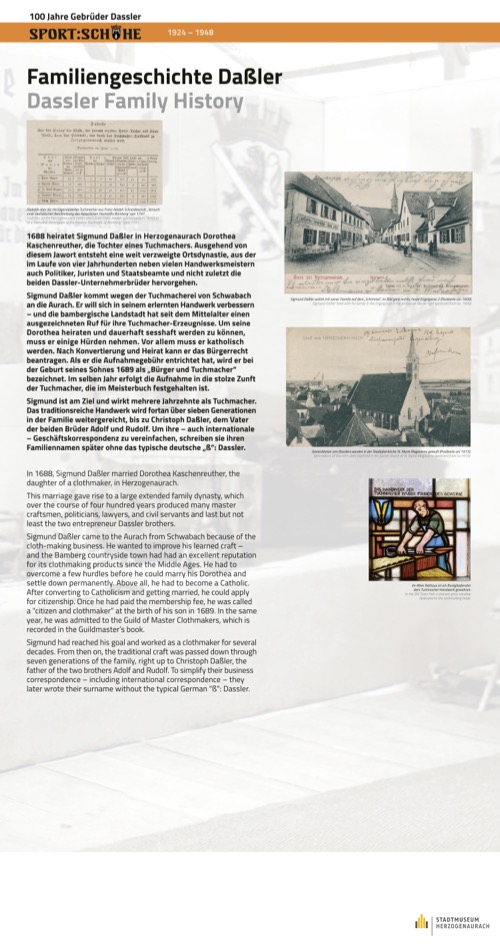
1688 heiratet Sigmund Daßler in Herzogenaurach Dorothea Kaschenreuther, die Tochter eines Tuchmachers. Ausgehend von diesem Jawort entsteht eine weit verzweigte Ortsdynastie, aus der im Laufe von vier Jahrhunderten neben vielen Handwerksmeistern auch Politiker, Juristen und Staatsbeamte und nicht zuletzt die beiden Dassler-Unternehmerbrüder hervorgehen.
Sigmund Daßler kommt wegen der Tuchmacherei von Schwabach an die Aurach. Er will sich in seinem erlernten Handwerk verbessern – und die bambergische Landstadt hat seit dem Mittelalter einen ausgezeichneten Ruf für ihre Tuchmacher-Erzeugnisse. Um seine Dorothea heiraten und dauerhaft sesshaft werden zu können, muss er einige Hürden nehmen. Vor allem muss er katholisch werden. Nach Konvertierung und Heirat kann er das Bürgerrecht beantragen. Als er die Aufnahmegebühr entrichtet hat, wird er bei der Geburt seines Sohnes 1689 als „Bürger und Tuchmacher“ bezeichnet. Im selben Jahr erfolgt die Aufnahme in die stolze Zunft der Tuchmacher, die im Meisterbuch festgehalten ist.
Sigmund ist am Ziel und wirkt mehrere Jahrzehnte als Tuchmacher. Das traditionsreiche Handwerk wird fortan über sieben Generationen in der Familie weitergereicht, bis zu Christoph Daßler, dem Vater
der beiden Brüder Adolf und Rudolf. Um ihre – auch internationale – Geschäftskorrespondenz zu vereinfachen, schreiben sie ihren Familiennamen später ohne das typische deutsche „ß“: Dassler.
In 1688, Sigmund Daßler married Dorothea Kaschenreuther, the daughter of a clothmaker, in Herzogenaurach.
This marriage gave rise to a large extended family dynasty, which over the course of four hundred years produced many master craftsmen, politicians, lawyers, and civil servants and last but not least the two entrepreneur Dassler brothers.
Sigmund Daßler came to the Aurach from Schwabach because of the cloth-making business. He wanted to improve his learned craft – and the Bamberg countryside town had had an excellent reputation for its clothmaking products since the Middle Ages. He had to overcome a few hurdles before he could marry his Dorothea and settle down permanently. Above all, he had t o become a Catholic. After converting to Catholicism and getting married, he could apply for citizenship. Once he had paid the membership fee, he was called a „citizen and clothmaker“ at the birth of his son in 1689. In the same year, he was admitted to the Guild o f Master Clothmakers, which is recorded in the Guildmaster’s book. Sigmund had reached his goal and worked as a clothmaker for several decades. From then on, the traditional craft was passed down through seven generations of the family, right up to Christoph Daßler, the father of the two brothers Adolf and Rudolf. To simplify their business correspondence – including international correspondence – they later wrote their surname without the typical German „ß“: Dassler.